
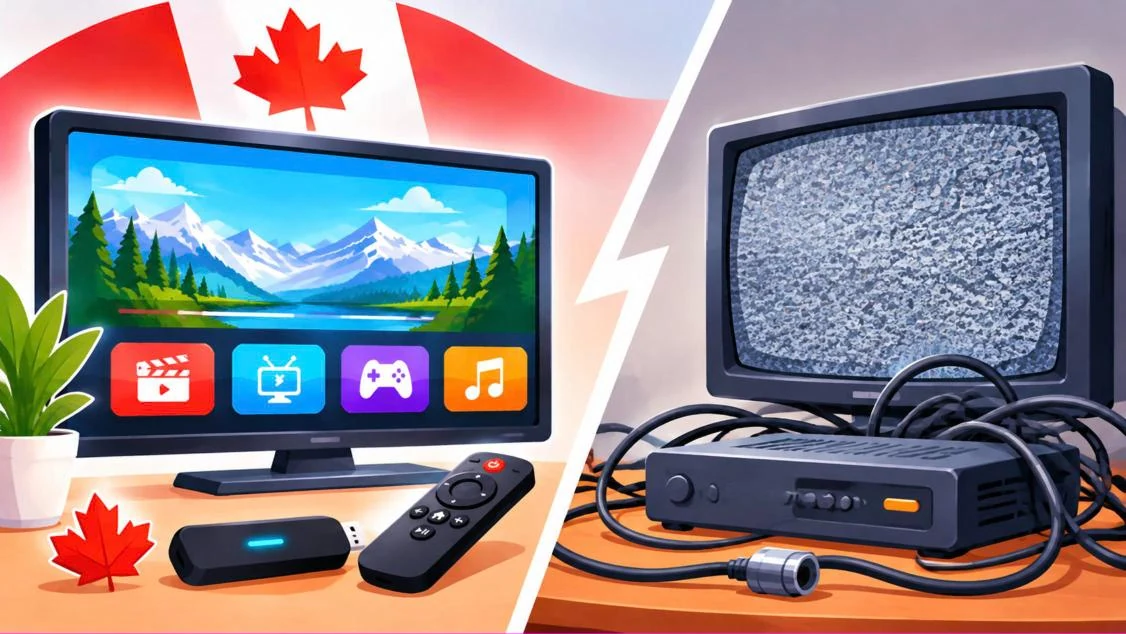
IPTV wins on cost and flexibility; cable wins on simplicity and guaranteed reliability. That’s the honest short answer to the IPTV-versus-cable question in Canada. A quality IPTV plan runs a fraction of a cable bill and ties you to nothing, but its picture quality depends on your internet and your provider, whereas cable arrives on a dedicated line that just works. Which one suits you comes down to how much you value saving money and flexibility against the plug-and-play certainty of traditional TV. This guide compares them head to head so you can decide.
Key takeaways
- Cost: cable runs $110–$200/month; a quality IPTV plan runs about $10–$15 — a saving of roughly $1,200–$2,200 a year.
- Reliability: cable’s dedicated line is rock-solid; IPTV depends on your internet and provider.
- Flexibility: IPTV has no contracts and works on any device; cable means boxes and commitments.
- Many people land on a hybrid: internet + IPTV + one streaming app.
Cost compared
This is the clearest win for IPTV. A realistic Canadian cable package with a sports tier runs $110–$200 a month once you add equipment rental, taxes and post-promotional pricing. A reliable IPTV subscription runs roughly $10–$15 a month on an annual plan. Over a year, that’s a difference of about $1,200–$2,200 for most households — even after adding a streaming service or two for originals.
| Cable | IPTV | |
|---|---|---|
| Monthly cost | $110–$200 | ~$10–$15 |
| Contract | Often 1–2 years | None |
| Equipment | Rented box(es) | Your own device |
| Hidden fees | Common | Fewer (check renewals) |
Our guide to affordable IPTV breaks the pricing down further.
Content and channels
IPTV typically offers a far wider lineup — including international and French-language channels cable bundles awkwardly or charges heavily for — plus an on-demand library. Cable’s lineup is narrower and pricier to expand, though it includes local and regional channels in a tidy, guaranteed package. For multicultural households and anyone wanting content from home, IPTV’s breadth is a major draw; for someone who only watches a handful of mainstream channels, cable’s simpler bundle may be enough. Judge this by your own must-watch list rather than raw channel counts, which both sides inflate.
Reliability
This is cable’s strongest card. A cable signal arrives on a dedicated line engineered for television, so it’s consistent regardless of what else is happening on your internet. IPTV rides your broadband connection, so its quality depends on both your internet and your provider’s infrastructure — a strong service on a wired connection matches cable, but a weak service or congested Wi-Fi will buffer. The gap narrows a lot once you wire your main device and choose a reliable provider, but it’s the honest trade-off: cable removes a variable that IPTV leaves in your hands. Our internet speed guide covers what you need for IPTV to feel cable-smooth.
Flexibility and contracts
IPTV is dramatically more flexible. There’s no installer visit, no equipment rental, and usually no contract, so you can start, stop, upgrade or switch whenever you like, and watch on any device in any room — or on the go. Cable ties you to a box, a location, and often a one- or two-year agreement with penalties for leaving. For renters, students, newcomers and anyone whose situation changes, that flexibility is worth a lot on its own, independent of the cost savings.
Equipment and setup
Cable comes with a rented set-top box and a professional (or self-) installation tied to your home. IPTV runs on hardware you already own or buy once — a streaming stick, an Android box, a smart TV app, a phone — and setup is a few minutes entering your login, as covered in our getting started guide. Cable is marginally simpler out of the box for the non-technical, but IPTV’s one-time, no-rental hardware is cheaper over time and not locked to one address.
Who should switch to IPTV
IPTV is the better fit if you want to cut a high cable bill, you already have solid internet, you value flexibility and no contracts, or you want international, French-language or a very broad channel lineup. It’s especially strong for cord-cutters, multicultural households, renters and anyone comfortable with a few minutes of setup. If that’s you, the savings and flexibility usually make the switch an easy call — screen providers with our guide to choosing an IPTV provider first.
Who should stick with cable
Cable still makes sense for some households: those with slow or unreliable internet, people who want absolute plug-and-play simplicity with zero setup, or anyone who values a single guaranteed signal over saving money and doesn’t mind the premium. If your internet can’t comfortably handle HD streaming, cable’s dedicated line may genuinely serve you better until that changes. There’s no shame in it — the right answer depends on your priorities, not on which technology is newer.
Can you combine both?
You don’t have to pick a pure side. A very common setup is to keep your internet, add a reliable IPTV service for live TV and channels, and subscribe to one streaming app for originals — which together cost far less than a full cable package while covering nearly everything. Some people even keep a basic cable tier for guaranteed local channels and use IPTV for everything else. The point is that “cut the cord” doesn’t have to be all-or-nothing; build the mix that fits how your household actually watches. Our comparison of IPTV vs Netflix and Crave helps with the streaming side of that mix.
The real-world experience, day to day
Numbers aside, the everyday feel of each is worth picturing. With cable, you turn on the box and the channel is simply there — no thinking about Wi-Fi, no app to open, the same guide every night. That consistency is genuinely pleasant, and it’s what long-time cable users miss most when they consider switching. With IPTV, the experience is more modern and more flexible: a slick app with a searchable guide, on-demand libraries, favourites you curate, and the freedom to pick up the same service on your phone in another room or another city. Once it’s set up well on a solid connection, day-to-day IPTV feels at least as good as cable and often better, but it does ask for that initial setup and a dependable internet connection. The honest framing is that cable trades money and flexibility for zero-thought simplicity, while IPTV trades a little setup for big savings and far more freedom.
What changes when you switch
If you move from cable to IPTV, a few things change that are worth anticipating so there are no surprises. Your TV bill drops sharply, but it becomes your responsibility to keep your internet solid, since that’s now the foundation of your viewing. You’ll return the rented cable box and instead use a streaming device you control. Recordings move from a cable PVR to app-based recording or catch-up, depending on your service and player. And you gain the ability to watch across devices and locations that a cable box never offered. None of these are drawbacks exactly — they’re shifts in where the responsibility and the flexibility sit. Going in aware of them makes the transition smooth, and most people adapt within the first week.
Making the decision
Boil it down to a few honest questions about your own household. Is your internet reliable enough for HD streaming, ideally with a wired option at the main TV? How much do you actually spend on cable now, and what would you do with $1,000+ a year? Do you value flexibility and a broad channel lineup, or pure simplicity above all? And are you comfortable with a few minutes of setup and choosing a reliable provider? If your answers lean toward saving money, flexibility and good internet, IPTV is the move. If they lean toward simplicity and you have connectivity concerns, cable keeps its place. Either way, the lowest-risk way to find out is to test IPTV alongside your current cable for a short period and compare them directly in your own home before cancelling anything.
Bottom line
IPTV beats cable decisively on cost and flexibility and usually on channel breadth; cable’s remaining advantages are guaranteed reliability on a dedicated line and plug-and-play simplicity. If you have good internet and want to save $1,000+ a year with no contract, IPTV is the clear move; if rock-solid simplicity matters more than money, cable still has a case. For many Canadians the smartest answer is a hybrid. To see how IPTV performs on your own connection before deciding, TVNow offers a 24-hour free trial.
Frequently asked questions
Is IPTV cheaper than cable in Canada?
Yes, substantially. Cable runs $110–$200 a month; a quality IPTV plan runs about $10–$15, saving most households roughly $1,200–$2,200 a year.
Is IPTV as reliable as cable?
Cable’s dedicated line is more consistent. A strong IPTV provider on a wired connection comes close, but IPTV quality depends on your internet and provider.
Does IPTV have more channels than cable?
Usually yes, including international and French-language channels cable bundles poorly — but judge by your own must-watch list, not raw counts.
Do I need to cancel cable to use IPTV?
No. Many people keep internet (and sometimes a basic cable tier) and add IPTV plus one streaming app, which still costs far less than full cable.
Who should stay with cable?
Households with slow or unreliable internet, or anyone who prioritises plug-and-play simplicity and a guaranteed signal over saving money.
What internet speed do I need to replace cable with IPTV?
Enough headroom for HD or 4K with other devices online too; a wired connection matters most. See our internet speed guide for specifics.