

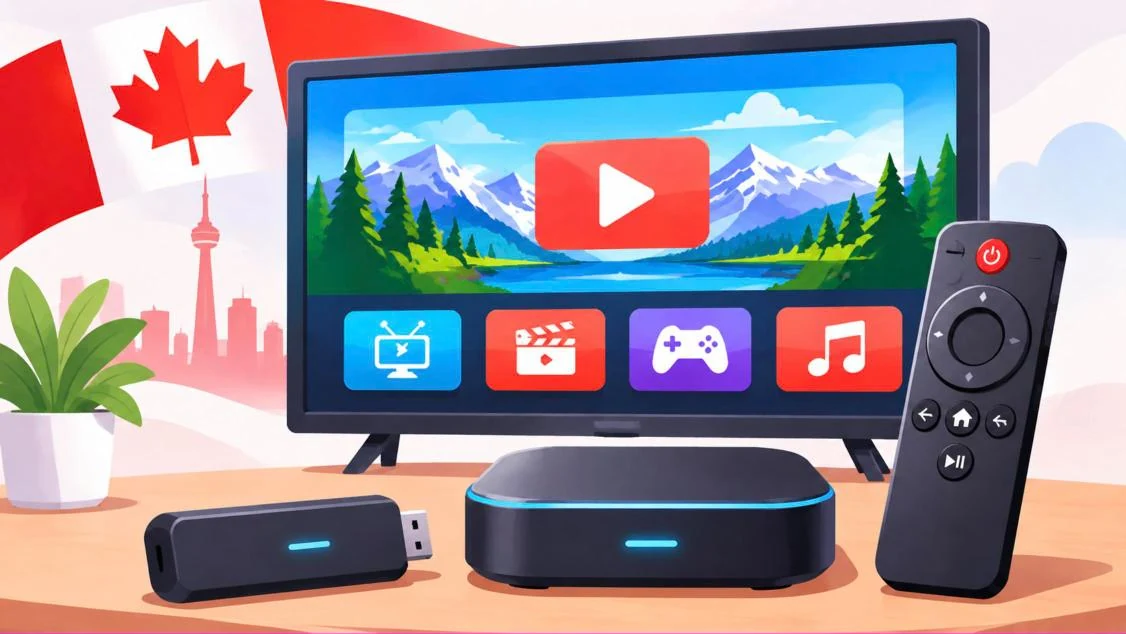
The best IPTV box for most Canadians is a mid-range Android TV / Google TV box with an Ethernet port — but the right choice depends on your budget and what you watch. There are five broad types of box, from cheap streaming sticks to premium media players and dedicated IPTV units, and each suits a different kind of viewer. This guide walks through every category, who each one is for, what to look for when buying, and which to avoid — so you can pick with confidence rather than guessing.
Key takeaways
- An Android TV / Google TV box with Ethernet is the best all-round choice for most people.
- Streaming sticks (Firestick) are the budget pick; Nvidia Shield is the premium one.
- Dedicated IPTV boxes like Formuler and BuzzTV suit enthusiasts who want a TV-like experience.
- Prioritise a fast processor and an Ethernet port over a big channel count on the box page.
Quick answer: which box for whom
If you want the short version: most people are best served by a mid-range Android TV box; budget-conscious buyers should get a Firestick; those who want the smoothest premium experience should look at an Nvidia Shield; enthusiasts who want a dedicated, cable-like interface should consider a Formuler or BuzzTV; and anyone with a recent smart TV may not need a box at all. The sections below explain the trade-offs so you can match one to your situation. For the basics of what a box does, see our guide to what an IPTV box is.
Android TV / Google TV boxes
These are the sweet spot for most households. Running the Android/Google TV operating system, they offer full access to IPTV player apps like TiviMate and IPTV Smarters, handle big channel lists smoothly if you buy a decent model, and usually include an Ethernet port for stable live TV. They range from budget to premium, so you can spend to match your needs. The main caution is avoiding the very cheapest no-name units, which feel sluggish within a year. Our dedicated Android TV box guide covers specific considerations.
Premium boxes: Nvidia Shield
At the top end, the Nvidia Shield is the box enthusiasts reach for. It has a powerful processor, excellent app support, strong 4K and HDR handling, and the kind of responsiveness that makes navigating a large channel list effortless. It costs considerably more than a basic box, so it’s overkill for casual viewers, but for a main living-room setup where you want the best possible performance for years, it’s a popular long-term investment. If buffering during live sport is your pet hate, premium hardware plus a wired connection is the surest fix.
Dedicated IPTV boxes: Formuler and BuzzTV
Some boxes are built specifically with IPTV in mind. Lines like Formuler and BuzzTV run Android but come tuned for a TV-like experience, often with polished interfaces and remotes designed for live-channel navigation. They appeal to enthusiasts who want something that feels purpose-built rather than a general streaming box. They sit in the mid-to-upper price range and are a solid choice if you treat IPTV as your main TV source. See our Formuler setup guide and BuzzTV guide for the details.
Streaming sticks: Firestick and Onn
Streaming sticks are the budget entry point. An Amazon Firestick is cheap, portable, and perfectly capable of running IPTV via a sideloaded player, which makes it the most popular starting device in Canada. Low-cost alternatives like the Onn 4K box offer similar value on Google TV. The trade-offs are that budget sticks can struggle with very large channel lists, and most rely on Wi-Fi rather than Ethernet unless you add an adapter. For casual viewing or a second TV, though, they’re hard to beat on price. Our Firestick guide walks through setup, and our Android box vs Firestick comparison helps you choose.
MAG and Linux boxes
MAG-style boxes run dedicated Linux firmware and connect to portal-based (Stalker) IPTV services rather than the M3U or Xtream logins most apps use. They’re stable and set-and-forget, which some users love, but they’re less flexible than Android boxes and are really only the right pick if your provider is portal-based. If you’re running one, our MAG box guide covers the specifics.
Smart TV built-in: maybe no box needed
Don’t overlook the option of no box at all. A recent Samsung, LG, or Google TV-based smart TV can run IPTV apps directly, which may be all you need. The trade-off is that TV hardware is often slower than a dedicated box and app choice can be limited, so if your TV struggles, adding a cheap box solves it instantly. For most people it’s worth trying the TV’s own apps first before buying hardware.
What to look for when buying
Whatever category you choose, the same specs matter. Prioritise a fast processor and enough RAM so navigation stays smooth, an Ethernet port for buffer-free live sport, 4K and HDR support if you have a 4K TV, enough storage for your apps, and confirmed app compatibility with the player you want to use. Ignore any “channels included” claims on a box listing — the box is just hardware; your subscription supplies the channels.
Boxes to avoid
Steer clear of two things. First, ultra-cheap no-name boxes with vague specs, which are usually underpowered and short-lived. Second, and more importantly, any box sold as “fully loaded” or “pre-loaded with all channels” — these are marketed around pirated content, raise legal and security concerns, and tie you to whatever unlicensed service they’re configured for. Buy a clean box and add your own legitimate subscription instead, as our guide to licensed vs unlicensed IPTV explains.
How to set up any box
Regardless of type, setup follows the same pattern: connect the box to your TV by HDMI and to the internet (Ethernet where possible), install an IPTV player app, and enter your M3U or Xtream Codes login. Our getting started guide covers the full process, and most boxes are watching within about ten minutes.
Match the box to your TV and internet
A box only performs as well as the setup around it, so match it to your TV and connection. There’s little point pairing a top-end 4K box with an older 1080p TV, or buying a premium unit then running it over weak Wi-Fi in a far room — the weakest link sets the experience. If you have a 4K HDR TV and fast internet, a capable box with 4K support and Ethernet lets you enjoy the full quality. If your TV is 1080p or your internet is modest, a mid-range box is plenty and the extra spend on a premium unit is wasted. The same logic applies to where the box lives: the main living-room TV where you watch sport deserves the better box and a wired connection, while a bedroom or guest TV can run a cheap stick. Thinking about the whole chain — TV, box, connection — rather than just the box in isolation is how you avoid both overspending and underperformance.
How long a box lasts and when to upgrade
A decent box should serve you well for several years, while the cheapest no-name units often feel sluggish within twelve months as apps grow heavier. Signs it’s time to upgrade include slow navigation, apps that crash or won’t update, no support for newer video formats, and struggling with large channel lists that used to scroll fine. Because the box and the subscription are separate, upgrading hardware is painless — you keep your service and simply move your login to the new device, ideally restoring your favourites from a backup. Buying slightly above the bare minimum up front usually pays off, since a capable box outlives two or three bargain ones and spares you the hassle of replacing it. Treat the box as a multi-year purchase rather than a disposable gadget and the maths favours quality.
Where and how to buy
Buy from mainstream, reputable retailers rather than marketplace sellers offering boxes “pre-configured” with channels. A clean box from a known brand gives you warranty support, genuine hardware and no unwanted pirated software, and you then add your own legitimate subscription — which is both safer and more flexible. Avoid any listing that leans on channel counts, “lifetime TV,” or “fully loaded” language, as covered above. If you’re unsure which specific model to get within a category, our device-specific guides walk through the popular options, and the simplest approach is to pick a well-reviewed box in your budget with the specs listed earlier, then test your service on it during a free trial before committing to a longer plan.
Bottom line
For most Canadians, a mid-range Android TV box with an Ethernet port is the best IPTV box — capable, flexible and affordable. Go cheaper with a Firestick, premium with an Nvidia Shield, or dedicated with a Formuler or BuzzTV depending on your needs, and check whether your smart TV already does the job. Prioritise processor, RAM and a wired connection, avoid “fully loaded” boxes, and pair whatever you choose with a legitimate subscription. To test streaming on your box, TVNow offers a 24-hour free trial.
Frequently asked questions
What is the best IPTV box in Canada?
For most people, a mid-range Android TV box with an Ethernet port. Firestick is the budget pick, Nvidia Shield the premium one, and Formuler or BuzzTV suit enthusiasts.
Do I need an IPTV box if I have a smart TV?
Not necessarily. A recent smart TV can run IPTV apps directly. Add a box only if your TV is slow or lacks the app you want.
What specs matter most in an IPTV box?
A fast processor, enough RAM, an Ethernet port, 4K/HDR support if needed, and compatibility with your chosen player app.
Should I buy a “fully loaded” IPTV box?
No. “Fully loaded” boxes are marketed around pirated content and carry legal and security risks. Buy a clean box and add a legitimate subscription.
Is a Firestick good enough for IPTV?
For casual viewing or a second TV, yes. For a main setup with big channel lists and live sport, a dedicated box with Ethernet performs better.
Does the box include channels?
No. The box is hardware; you add a separate IPTV subscription, which means you can switch providers without replacing the box.







